Categories
This site is based upon MediaWiki. MediaWiki has no folders or directories. Every page lives in a single flat namespace — there's no location to save a page into, the way you would file a document into a folder. Organisation instead comes entirely from categories: you tag a page by inserting anywhere in its wikitext, and this automatically lists the page on the appropriate category page and creates a link at the bottom of the article back to that category. A page can carry more than one category, and because each category is itself just another page, which can in turn be categorised, categories can be stacked into hierarchies — parent categories with subcategories beneath them, subcategories with their own subcategories, and so on, in place of the folder tree a normal file system would give you. What's critical in this model isn't the mechanics of tagging — it's establishing the ontology: the actual shape of the hierarchy, which categories are parents of which, and where a new kind of page should sit within it. That ontology is a work in progress on iwiki.au, not a fixed schema decided once and left alone. As new pages come online and new kinds of entities need documenting, new categories get created and slotted into the existing structure — which means the taxonomy itself is expected to grow and shift as the wiki's coverage does, not something a contributor should treat as closed.
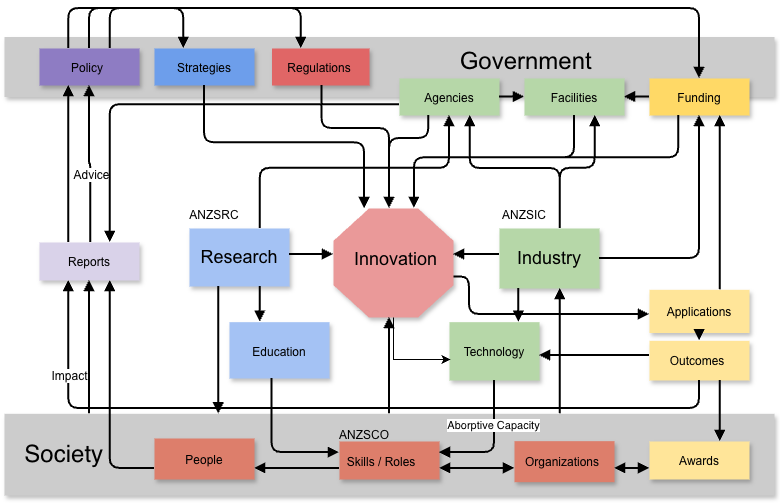
On the IWiki the ontology is centred on Innovation with a simple tree
- Government at the top (with Policy, Strategy and Regulations)
- Supported by various Agencies, Facilities and Funding
- Research on the left (divided into different Research Sectors), connected to Education
- Industry on the right (divided into different Industry Sectors, connected to Technology
- Society on the bottom (with People with Roles and skills
- Which leads to desired Applications and Outcomes
- Supported by Organisations with various Structures
- To write Reports to advise government.
Warning: This image is a work in progress.